

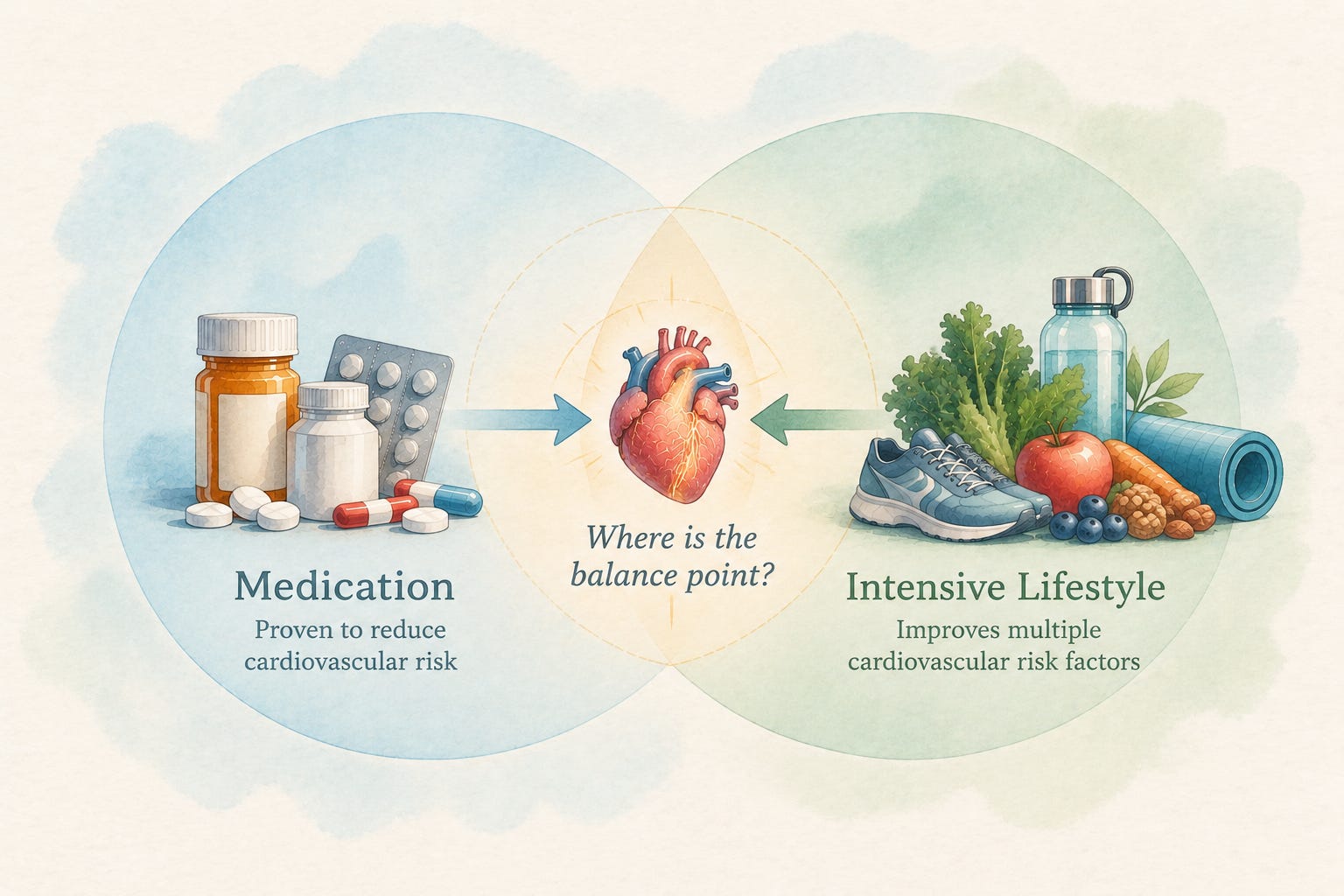
A close friend recently received a stent in his “Widow Maker” artery and enrolled in Dr. Ornish’s intensive lifestyle program. Nearly 40 years ago, Dr. Dean Ornish showed that lifestyle changes could actually reverse some coronary artery narrowing.
This sent me digging to learn more about the Ornish Program and whether it can prevent a heart attack. It also made me wonder whether it’s still necessary today, given how low we can now drive cholesterol.

A friend recently had a coronary scan that suggested significant narrowing in his left anterior descending (LAD) coronary artery — the “widow maker,” as every TV crime ME likes to exclaim. My friend went in for an exploratory cardiac catheterization and came out with a shiny new stent.
After the procedure, his doctor prescribed cardiac rehab, the Ornish Program for Reversing Heart Disease, and medication to lower LDL below 55 mg/dL, a current treatment target for people with established disease.
My friend is doing great, but his experience sent me digging. And even though this isn’t about brain health, since, as the song goes, the heart bone is connected to the brain bone, I feel this research is right up my alley!

Nearly 40 years ago, Dr. Dean Ornish conducted a revolutionary trial. He first reported the one-year results of his Lifestyle Heart Trial in 1990, and the five-year follow-up results in 1998. They found that narrowing in the coronary arteries actually regressed! Over five years, the average narrowing decreased by about 3 percentage points in the lifestyle group, while it increased by roughly 11 percentage points in the control group. Pretty remarkable, right?
So what is the Ornish Program? It’s a lifestyle practice that combines a low-fat, vegetarian diet (roughly 10% of calories from fat), regular exercise, stress management, group support, and quitting smoking (where applicable). That’s all there is to it, no statins or handfuls of supplements.
Speaking of cholesterol, LDL cholesterol fell by roughly 40% in the lifestyle group in the first year. By year five, however, LDL rose but still remained about 20% below its starting level.
The trial had some major limitations. The study was small: just 48 participants enrolled, and 35 completed the five-year follow-up. Women were not represented in the lifestyle group: only one entered, and none completed the full trial.
They measured artery narrowing, not plaque volume or makeup. So we don’t know whether the regression (or progression) was accompanied by similar changes in arterial plaque.
Most importantly, although researchers reported fewer cardiac events in the lifestyle group, the study was too small to determine whether lifestyle changes reduced heart attacks or cardiovascular deaths.

A trial with only 48 participants remains central to the claim that intensive lifestyle changes reverse coronary disease. This is surprising to me, especially given the near absence of women in the original lifestyle group when heart disease is the number one killer of women over age 65.
I have found subsequent studies with more participants, including women, that show improvements in cardiovascular risk factors and other encouraging results when implementing lifestyle changes. This is good news for the Ornish Program. But these studies don’t resolve my central question: Does the Program reduce heart attacks or cardiovascular deaths, particularly when combined with today’s medications?
I’ll keep looking, but I still haven’t found a large randomized trial that answers that question.
What about LDL?
When I move past the trial's limitations, I'm fascinated that Dr. Ornish achieved these results at a time when lipid-lowering drugs were in their infancy. Today, medications can lower LDL levels remarkably. Yet, the trial achieved regression of coronary narrowing even though LDL levels were well above today’s targets. For example, by year five, the lifestyle group’s LDL average was 115 mg/dL.
This makes me wonder whether lifestyle interventions can improve coronary narrowing by doing more than just lowering LDL, potentially changing the LDL calculus:
Maybe we don’t need to drive LDL quite so low if we make enough lifestyle changes?
Or, maybe we don’t need these lifestyle changes at all if we can get LDL low enough?
Or, maybe if our arteries are more open, much of the rest of the discussion is moot?
Follow the Data
Unfortunately, we don’t know how much added protection the Ornish Program provides alongside today’s cholesterol-lowering treatments. Among the approaches I’ve researched, the strongest evidence for reducing heart attacks comes from large clinical trials of LDL-lowering treatments.
Surprisingly, the evidence is different when it comes to routinely opening narrowed coronary arteries. In stable coronary disease (like my friend), large trials have generally found that an invasive strategy does not reduce heart attacks or deaths more than appropriate medical therapy alone. Still, stents can relieve symptoms, and they play an often lifesaving role during acute heart attacks.
Where to Go From Here?
When I started researching the Ornish Program, I saw it as the gold standard. I now have a new perspective. Dr. Ornish showed exciting results, but the research has limits, and other lifestyle approaches also show strong evidence. For example, the Mediterranean diet has shown cardiovascular benefits, and a Medicare study of the less restrictive Benson-Henry Program found encouraging results, including fewer hospitalizations than matched comparison patients.
So, what about my friend? He’s determined to do both lifestyle changes and aggressive cholesterol lowering, taking a best-of-both-worlds approach. Given what we know about LDL lowering and the cardiovascular benefits of lifestyle changes, this seems like a pretty good bet — at least until we have better data on how much additional protection the combination provides.

The Ornish Lifestyle Heart Trial
Ornish et al., “Can Lifestyle Changes Reverse Coronary Heart Disease?” — The Lancet, 1990.
Ornish et al., “Intensive Lifestyle Changes for Reversal of Coronary Heart Disease” — JAMA, 1998.
Ornish et al., “Avoiding Revascularization With Lifestyle Changes: The Multicenter Lifestyle Demonstration Project” — American Journal of Cardiology, 1998.
Koertge et al., “Improvement in Medical Risk Factors and Quality of Life in Women and Men With Coronary Artery Disease” — American Journal of Cardiology, 2003.
Daubenmier et al., “The Contribution of Changes in Diet, Exercise, and Stress Management to Changes in Coronary Risk in Women and Men” — Annals of Behavioral Medicine, 2007.
Medicare and Intensive Lifestyle Programs
Zeng et al., “Benefits and Costs of Intensive Lifestyle Modification Programs for Symptomatic Coronary Disease in Medicare Beneficiaries” — American Heart Journal, 2013.
LDL Lowering and Cardiovascular Events
Sabatine et al., “Evolocumab and Clinical Outcomes in Patients with Cardiovascular Disease” — NEJM, 2017. FOURIER trial.
Cannon et al., “Ezetimibe Added to Statin Therapy after Acute Coronary Syndromes” — NEJM, 2015. IMPROVE-IT trial.
Stents Versus Medical Therapy
Maron et al., “Initial Invasive or Conservative Strategy for Stable Coronary Disease” — NEJM, 2020. ISCHEMIA trial.
Alternative Lifestyle Approaches