

This Field Note is different: instead of focusing on one research paper, I’m taking a more personal angle.
I’m Starting to Wonder
As I got ready to write my next Field Note, I felt uneasy sorting through my queue of new research and articles. I’ve built a software program that crawls the interwebs for brain-health articles and summarizes them. Today’s queue includes hearing loss, heading a soccer ball as a kid, and the risks of drinking bottled water.
For me, every new headline becomes another thing to dig into, weigh, and maybe even lead me to make changes in my life. It feels heavy.
My growing lack of joy around writing these Field Notes has my number-one fan encouraging me to shift gears and use the funny side of my brain to make people laugh, rather than write about one more ominous connection.
Enter Kevin Bacon
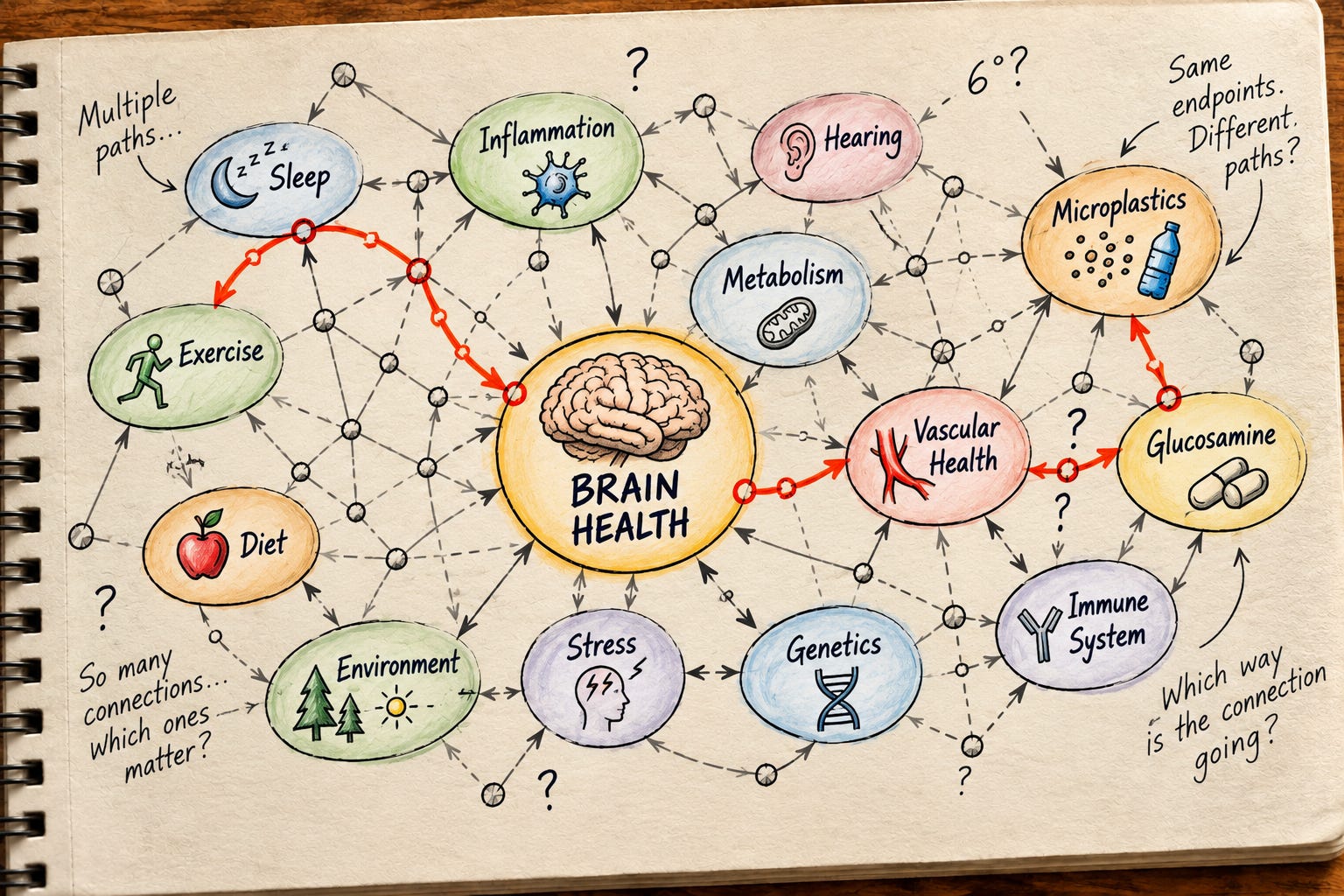
After thinking about it, I feel like I’m playing the Kevin Bacon game of brain health — and that framing helps me explain why so many things seem connected.
As every actor connects to Bacon, everything I read seems to connect to brain health or dysfunction. For non-Boomer readers, the Six Degrees of Kevin Bacon game shows how virtually any actor connects to Kevin Bacon through a surprisingly small number of films and co-stars. For example, since Meryl Streep co-starred with Kevin Bacon, she has a Bacon number of “1.” Mark Hamill, on the other hand, connects through Carrie Fisher and John Belushi, giving him a Bacon number of “3.”
Just like Hollywood, our immune system, digestive system, metabolism, vascular health, sleep, inflammation, sensory systems, and brain are so interconnected that multiple paths connect any two points, some short and some long.
This was quite a revelation for me. Instead of seeing a new headline and thinking, “oh, crap, yet another thing might lead to dementia,” this gives me the wherewithal to say, “Of course there’s a connection.” Finding the connection is the easy part; the hard part is determining whether that path actually holds up.
And that gives me a new motto for Field Notes: Expect the connection. Walk the path.
Here are a few examples to show what I mean:
Microplastics: Which Way Are We Going?
I’ve recently started avoiding drinking bottled water, especially after it’s been in a hot Florida car, because of concerns about microplastics. Then I found research by Nihart et al. that discovered substantially higher concentrations of micro- and nanoplastics in the brains of people with dementia. If you scour the blogosphere, there are plenty of people touting this research—and related work—as proof that microplastics lead to dementia.
However, the researchers themselves are cautious about their findings. This is a chicken-and-egg situation. Which came first? Microplastics might contribute to disease, or changes associated with dementia, including impaired clearance, might cause more plastic to accumulate in the brain.
Essentially, which way is the arrow pointing: microplastics to dementia, or dementia to microplastics? There is a connection, but we need to know much more before we can say whether microplastics contribute to dementia.

Glucosamine? Really?
When I first looked into this, I thought I’d found some good news. Research from the UK Biobank associated glucosamine use in people without dementia with a lower subsequent risk of dementia, including Alzheimer’s. In this case, researchers started with people without dementia and followed them forward.
But before raiding your dog’s Cosequin supply, hang tight—the next study starts elsewhere.
A 2026 University of Florida study seems to point in the opposite direction. In a retrospective analysis of health records, people with mild cognitive impairment (MCI) who had documented glucosamine use were more likely to subsequently progress to Alzheimer’s disease and related dementias than those without documented glucosamine use.
When I started walking the path, I realized why these seemingly contradictory findings are so difficult to compare. The studies weren’t asking the same question. The UK research started with people without dementia; the Florida study started with people who already had MCI or Alzheimer’s disease and related dementias.
Same glucosamine. Different populations. Different questions. Different paths.
A Priest, A Minister, and a Rabbit Walked Into A Bar
Okay, maybe the president of my fan club has a point.
I started this note wondering whether researching brain health was becoming more anxiety-producing than useful. But I don’t need to freak out every time my web creepy crawler drops another scary item into my queue. I can expect the connection and see where the path takes me. Maybe you can, too.
I’m definitely adding Field Jokes from time to time. If we can laugh together, maybe the path we’re walking will be a little more fun.
The bartender looks at the rabbit and asks, “What happened to you? Autocorrect?”
Oddly, I feel better now. See you soon with another Field Note.
Source Links
Microplastics — Nature Medicine (2025)
Nihart AJ, Garcia MA, El Hayek E, et al. “Bioaccumulation of microplastics in decedent human brains.” Nature Medicine 31, 1114–1119. Nature
Nature Medicine — full paper
Glucosamine & Alzheimer’s progression — Nature Metabolism (2026)
Hawkinson TR, Liu Z, Ribas RA, et al. “Hyperglycosylation is a metabolic driver of Alzheimer’s disease.” Nature Metabolism 8, 1410–1425. This is the University of Florida study containing the MCI/glucosamine analysis you discuss. DOI
Nature Metabolism — full paper
Glucosamine & dementia risk — BMC Medicine (2023)
Zheng J, Ni C, Zhang Y, et al. “Association of regular glucosamine use with incident dementia: evidence from a longitudinal cohort and Mendelian randomization study.” BMC Medicine 21, 114. This is the UK Biobank paper you’re contrasting with the UF study. DOI
BMC Medicine — full paper
I enjoy your field notes and I’m sorry they are stressing you out! It’s true, lots of research is comparing apples to oranges and it’s hard to compare. I like that you are thinking deeply about these issues. Keep on keeping on 😀