

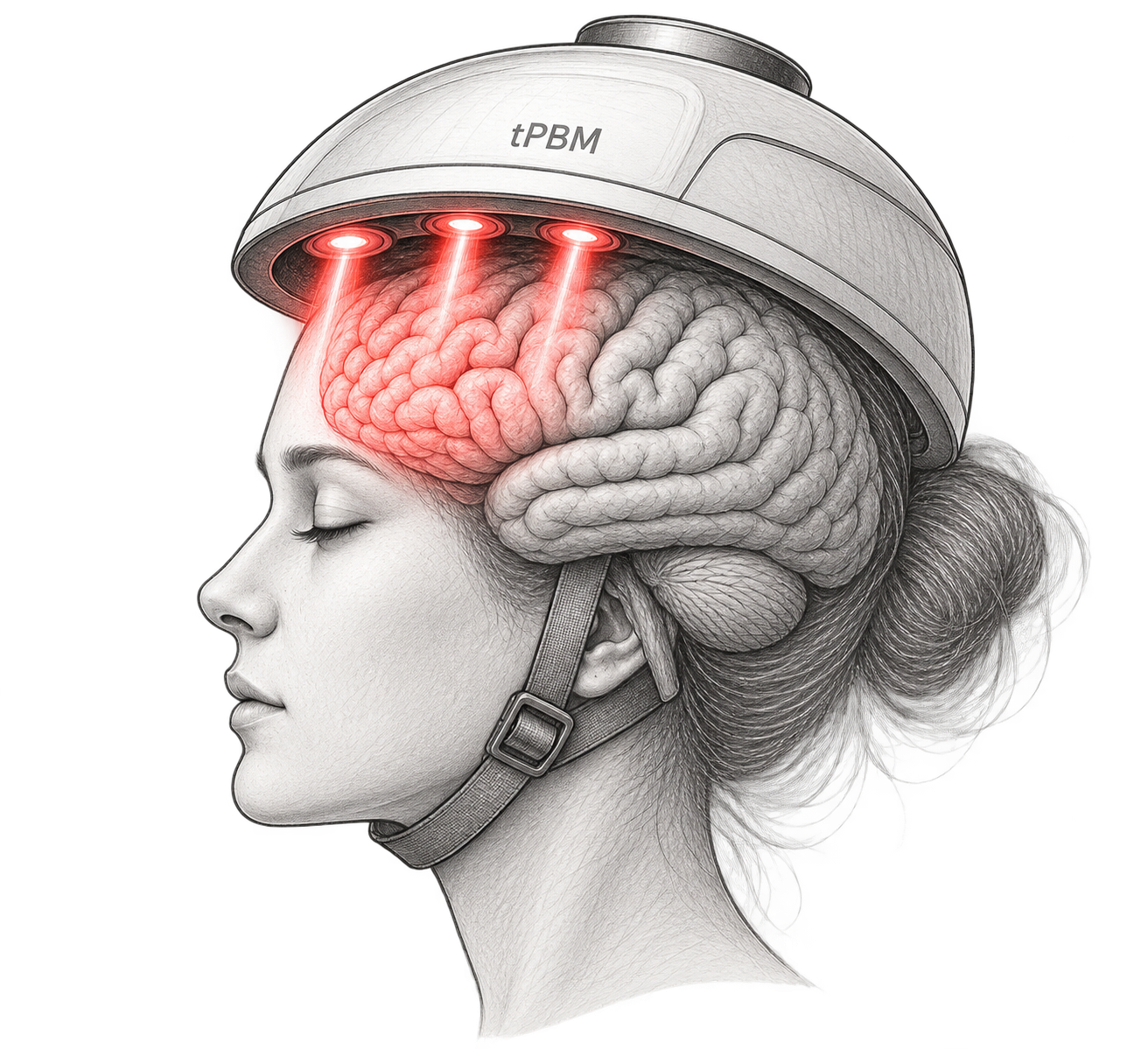
A well-designed 2026 Korean study found striking cognitive improvement in people with mild cognitive impairment (MCI) using a home light device. To my surprise, the effect is larger than anything drug trials have achieved for people dealing with this challenge. Even so, it’s important to understand what the researchers tested—and what they didn’t—so we can figure out what to make of this exciting study.

With a headline like “home-based light therapy helmet shows dramatic cognitive performance improvement,” my first thought was that this is one step away from wearing tin foil hats! However, the findings and theory made me rethink my position:
People using a photobiomodulation (PBM) device showed significant improvement on cognitive tests. These performance gains are better than any Alzheimer’s drug trial has achieved.
PBM sits squarely in my upstream hypothesis for this entire series. There is a growing belief that metabolic and vascular dysfunction may begin long before the downstream damage we associate with Alzheimer’s.
But before we get to the study results, it helps to have some background. For more than a century, researchers have experimented with different forms of energy, including electricity, magnetic fields, and light, to treat the brain. A few approaches have become accepted treatments (e.g., ECT and TMS), while many others sounded plausible but failed careful testing.
So where does PBM sit?

This double-blind 2026 study included 80 participants clinically diagnosed with mild cognitive impairment (MCI) due to Alzheimer’s Disease, randomized to an active or sham arm in a 12-week trial. Chun and the team went to great lengths to exclude people with MCI due to other conditions, including stroke, Parkinson’s, major depression, and vitamin B12 or folate deficiency. It was a surprise to me that so many other factors can trigger MCI.
All participants received a transcranial photobiomodulation (tPBM) helmet that positioned the light sources over the dorsolateral prefrontal cortex. This area is essentially the brain’s control center, which is involved in working memory, attention, planning, and mental flexibility. The sham (control) arm received 1/50th of the light intensity.
How can light waves penetrate the skull?
The skeptic in me walked into this study with three basic questions:
How can light waves penetrate the skull to affect the brain? It turns out that human and animal studies show that the right wavelength, intensity, and duration reaches the brain’s outer layers.
How can light affect brain functions? The leading theory begins in the neuron’s power plants (mitochondria). An enzyme in the cellular energy chain may absorb near-infrared light at 808 nm (as used in this study), potentially boosting ATP production (neuron fuel). The same reaction could also increase nitric oxide levels, dilating blood vessels and improving local blood flow. But this remains a working theory, and this trial did not test whether any of these mechanisms actually occurred.
Why shine a light on this part of the brain? Human and animal studies show reduced blood flow and metabolism in this brain region in patients with MCI and AD.
So, with a plausible biological story, let’s jump into the findings.

The Findings are Remarkable
Unlike several studies we’ve already seen in Field Notes, this one is very well designed. I'll spare you the gory details of the research methodology, but I did take a deep dive.
The findings are remarkable. After 12 weeks, there was about a five-point spread between the active and sham arms on the Korean version of the 30-point Montreal Cognitive Assessment (MoCA). The authors say this represents a “statistically and clinically meaningful effect.” In addition, scores on the MoCA and the MMSE (Mini-Mental State Examination, an older, less sensitive test than the MoCA) improved at both the seven- and 13-week test points.
So the outcome and the quality of the trial humbles the skeptic in me, but understanding what to do with the findings requires some context.

The researchers are clearly hopeful, concluding in the abstract that the results support tPBM “as a preventative strategy against AD.” As I explain below, I think that’s a stretch, but I understand why they say this. They view MCI as an early stage of AD, where addressing upstream metabolic or vascular dysfunction might still alter the downstream course of the disease.
Unfortunately, all we know from this research is that scores went up by a meaningful amount. The researchers did not measure what changed in the brain, so we cannot tell which biological pathway, if any, drove the improvement. Nor do we know whether the gains lasted beyond the trial. Essentially, we don’t know whether any preventive action is occurring.
So, I'm landing on a positive, yet cautious note. Both pieces of the puzzle are there. This study illuminates tPBM as a promising treatment, showing substantial improvements in cognitive performance. And we know that light at the right wavelength, intensity, and location can reach the brain’s outer layers and affect brain metabolism and blood flow. What we need is another independent research group to bring the pieces together by first reproducing the cognitive results and then testing what is actually happening in the brain.

If you or someone you know has MCI, pay attention. This is a recent study with unusually encouraging results, so it’s definitely worth discussing with a doctor.
MCI isn’t one thing, so dig deeper. Many potential causes of MCI may not align with AD.
The specific protocol is essential. Before replacing the bulb in your sunlamp with a red one, the researchers used a very specific dose of 808-nm near-infrared light, delivered to a specific brain location. We can’t assume that other doses, locations, or schedules will produce the same results, or even any results.
This study is about treatment, not prevention. So if you’re cognitively sound and want to use PBM to boost your cognitive strength or increase your chances of avoiding MCI or Alzheimer’s, unfortunately, this study doesn’t help you.

Chun et. al. 2026 — “Home-based transcranial photobiomodulation improves cognitive function in mild cognitive impairment due to Alzheimer’s disease: A randomized, double-blind, placebo-controlled confirmatory trial.”
Tedford et. al. 2015 — “Quantitative analysis of transcranial and intraparenchymal light penetration in human cadaver brain tissue.” Lasers in Surgery and Medicine. 2015;47(4):312–322. doi:10.1002/lsm.22343.
Pruitt et. al. 2020 — “Transcranial photobiomodulation (tPBM) with 1,064-nm laser to improve cerebral metabolism of the human brain in vivo.” Lasers in Surgery and Medicine. 2020;52(9):807–813. doi:10.1002/lsm.23232.
Fear et. al. 2023 — “Use of ^31P magnetisation transfer magnetic resonance spectroscopy to measure ATP changes after 670 nm transcranial photobiomodulation in older adults.” Aging Cell. 2023;22(11):e14005. doi:10.1111/acel.14005.
Baik et. al. 2021 — “Effects of photobiomodulation on changes in cognitive function and regional cerebral blood flow in patients with mild cognitive impairment: A pilot uncontrolled trial.” Journal of Alzheimer’s Disease. 2021;83(4):1513–1519. doi:10.3233/JAD-210386
Park et. al. 2023 “Correlation between cerebral hemodynamic functional near-infrared spectroscopy and positron emission tomography for assessing mild cognitive impairment and Alzheimer’s disease: An exploratory study.”

Given PBM's alignment with my upstream hypothesis, I'm excited to dig a bit deeper into the metabolic dysfunction that might be the earliest manifestation of cognitive dysfunction.
