

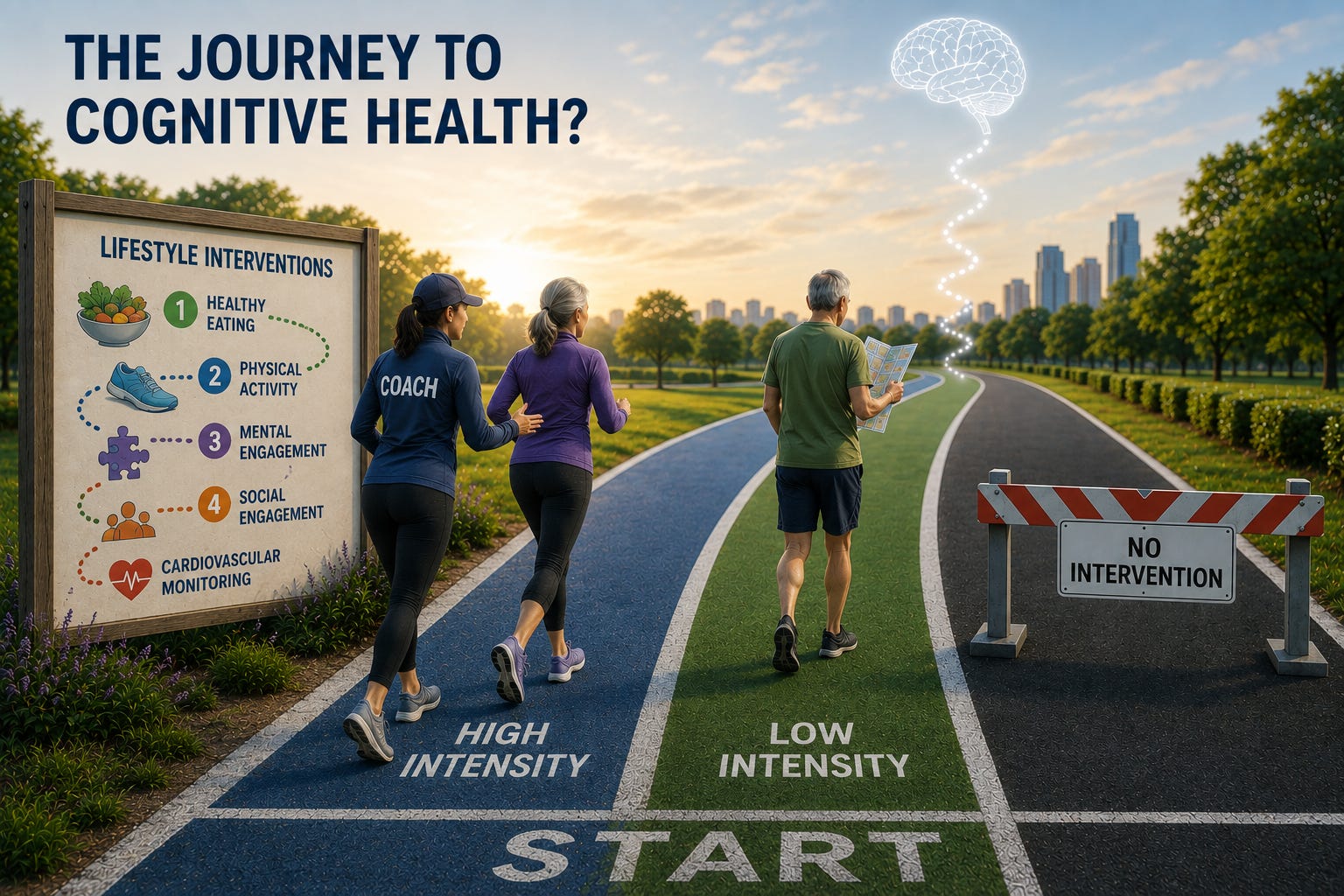
Does eating healthy, exercising, staying socially and mentally engaged, and managing your cardiovascular health protect your brain from cognitive decline? A major U.S. trial put this idea to the test with encouraging results. But there’s a catch: everyone in the trial received some level of lifestyle intervention. So, what does US-POINTER really tell us, and why are some brain-health practitioners calling it evidence that lifestyle changes can prevent dementia?

In this Field Note, we examine the 2025 US-POINTER trial and what it suggests about reducing your risk of cognitive decline. As we’ll see, the results require taking a close look, or it’s easy to see things that aren't really there.

First, let’s get the acronym soup out of the way. The OG for all of this research is FINGER (Finnish Geriatric Intervention Study to Prevent Cognitive Impairment and Disability), a Finnish study published in 2015. I’m focusing on the US-POINTER trial from 2025, which is based on FINGER.
POINTER is a convoluted acronym that would take half this blog to explain. There is also a related LatAm-FINGERS trial, recently presented at this year’s Alzheimer’s conference. It’s probably a good thing that these scientists work in research institutions rather than on Madison Avenue.
What I love about US-POINTER is that the objective is clear: “Can multidomain lifestyle interventions improve or protect cognitive function in older adults at risk of cognitive decline and dementia?” So, let’s get into the research:
It’s a randomized two-year trial of 2,111 older adults at risk of cognitive decline or dementia.
There were two groups. Both were encouraged to eat a healthy diet, exercise, engage mentally and socially, and have their cardiovascular health tracked.
The big difference between the groups was intensity. The high-intensity group had coaching and frequent meetings. The low-intensity group was provided with information on lifestyle changes and a handful of meetings over the two-year trial.
Two things to note about the trial:
US-POINTER did not compare implementing lifestyle change with doing nothing, so there was no true no-intervention control group.
The trial did not address sleep, a major contributor to cognitive health as well as dysfunction.

After two years, cognitive scores improved for both groups, with the high-intensity group doing slightly better. When researchers looked more closely at individual cognitive functions, however, there was no clear advantage for the high-intensity group in episodic memory performance. I find this disappointing because memory loss is a primary concern for most people. Executive function was the only area where the high-intensity group clearly outperformed the low-intensity group.
The overall findings are consistent with FINGER and LatAm-FINGERS, suggesting this isn't simply a one-off finding.

So, why all the excitement in the blogosphere over US-POINTER? The difference passed the statistical gate, but how much difference are we talking about?
Participants in the high-intensity group improved more than the low-intensity group by only 0.029 standard deviations per year. I think about it this way: Imagine your pediatrician tells you that your daughter moved from the 79th percentile in height to the 81st since the last visit. That’s a measurable change against all the other babies her age, but you wouldn’t look at her and think, “It’s time to start calling WNBA scouts.”

That's roughly the scale we're talking about with US-POINTER. Even the study authors acknowledged that the difference was so small that “assessing clinical significance is challenging.”
What I find fascinating is that both groups improved. Why? On the one hand, maybe lifestyle behavior education and minimal encouragement helped participants adopt healthier behaviors, leading to modest cognitive performance improvement. On the other hand, much of this improvement may be due to a known learning curve with repeated cognitive testing, especially over a short time frame like two years.
Still, even taking the improvement at face value, we need to be careful that we don’t read more into the results than is there:
Despite what you may hear about US-POINTER, the trial measured changes in cognitive performance, not whether the intervention prevented dementia. Nearly all participants were cognitively normal when the trial started.
The trial did not separate the effects of the individual lifestyle interventions. We don’t know whether we need to do them all or only one to achieve the same gain. I do find it interesting that executive function was the only metric that showed a clear benefit, and previous research has shown that exercise can improve executive function. Unfortunately, US-POINTER can’t tell us if exercise did indeed play an outsized role.
So, my bottom line is that a highly structured lifestyle program appears to provide a small additional benefit over a less intensive, self-guided program. Regardless, we should exercise, eat healthy, stay socially and mentally engaged, manage our cardiovascular risk, and get our sleep in order. These are low-risk interventions with benefits that extend well beyond cognition.

I’m excited that there are some actionable takeaways in this Field Note:
Don’t confuse better test scores with preventing dementia.
Don’t pay someone to enroll you in the “US-POINTER Protocol.” This is not Coca-Cola’s secret recipe. None of this is proprietary.

US-POINTER — Baker et al., JAMA (2025): Structured vs Self-Guided Multidomain Lifestyle Interventions for Global Cognitive Function: The US POINTER Randomized Clinical Trial
FINGER — Ngandu et al., The Lancet (2015): A 2 year multidomain intervention of diet, exercise, cognitive training, and vascular risk monitoring versus control to prevent cognitive decline in at-risk elderly people (FINGER)
LatAm-FINGERS (2026): Lifestyle Program Improves Brain Health Among Older Adults at Risk for Dementia Across Latin America

OK, I’ll acknowledge that for the past few Field Notes I’ve changed where I’m going next after diving into the research. However, this time, I’m pretty confident that in the next Field Note we’ll be shining a light on photobiomodulation and attempting to separate hype from reality.

I’m paying attention.
Another interesting and well-written field note Ted. Thank you. I wish the studies were more definitive and agree with you that we should nevertheless continue our healthy lifestyles. Perhaps after looking at photobiomodulation, you might consider researching Pulsed Electromagnetic Field (PEMF) and it's effect on cognition and inflammation. I am using Renona Health's Vibe product on the recommendation of Dr. Henry Frieder.