

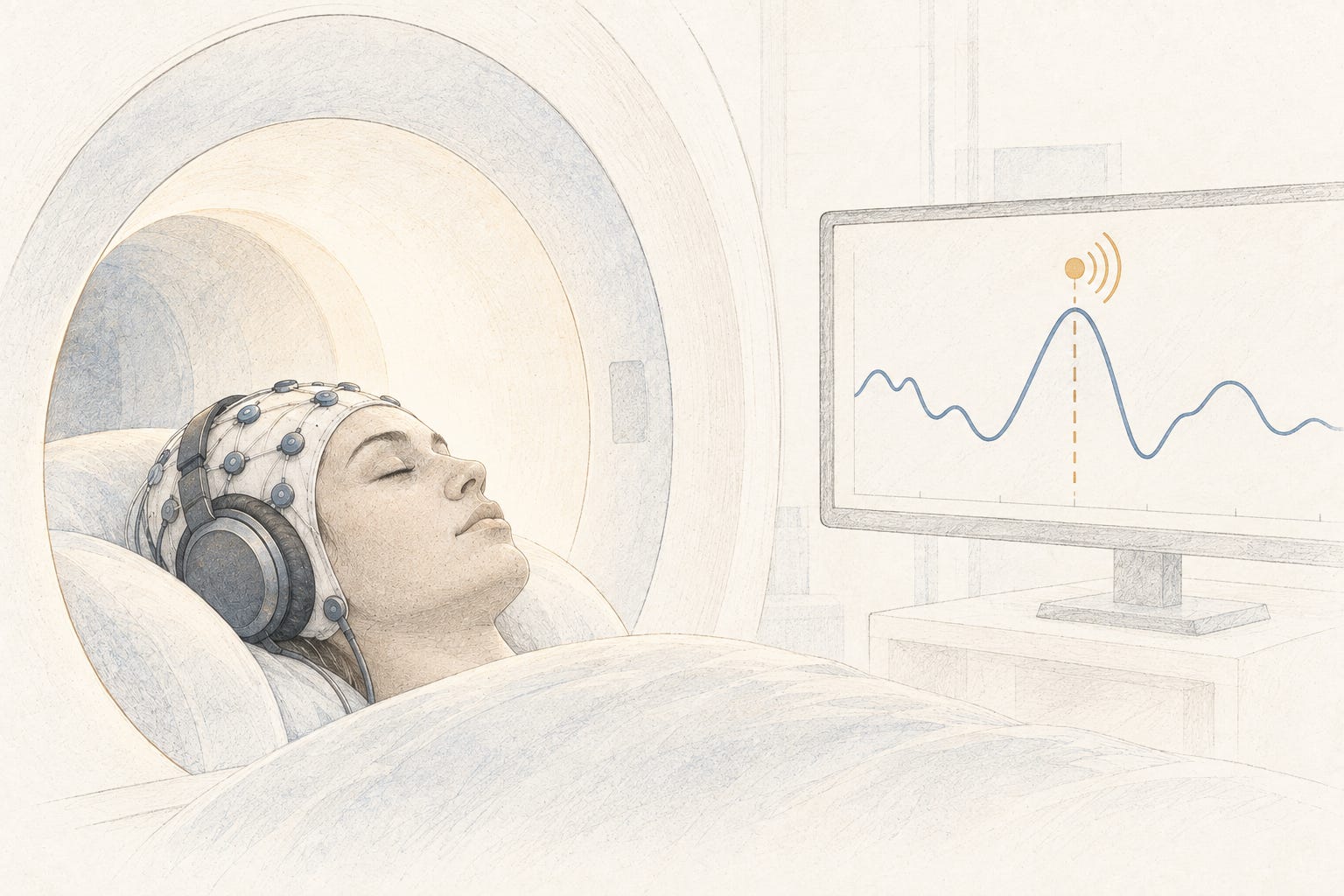
Sleep is essential for brain health, with poor sleep associated with cognitive decline and neurodegenerative disease. But while we sleep, something surprising happens: natural waves of cerebrospinal fluid (CSF) course through our brain. It’s unclear what these waves do, but one theory suggests they are related to the brain's waste management. Interestingly, these waves degrade with age, and CSF flow disruption has also been associated with Alzheimer’s and Parkinson’s. In this Field Note, we dive into ingenious new research that uses precisely timed sound to manipulate these waves during sleep.

For this Field Note, I intended to focus on an exciting technology called pulsed electromagnetic field (PEMF) therapy. That seemed like a logical follow-on to the last note on how photobiomodulation, another cool technology, can improve cognition in Alzheimer’s-related mild cognitive impairment (MCI). But something bugged me.
In cyber, the more mundane practices, like teaching staff to spot phishing attacks and training developers to build secure code, are often central to managing risk. It turns out that teaching Jack to recognize a phishing link can reduce overall risk as much as that next-generation security tool. The boring stuff matters.
So I’m extending this premise to protecting our brains by going back to basics. I’ll get back to the cool new tech soon, but in this field note, I’m focusing on new research that offers insight into one of the most mundane things we do: sleep.

A good night’s sleep is essential for brain health, and poor sleep is associated with cognitive decline. It can also be a symptom, particularly later in life, of neurodegenerative disease.
I always thought sleep’s contribution to memory processing was that it’s the time when the brain solidifies memories. However, I was surprised to learn that a lot more is going on.
The brain is essentially a closed system inside the skull: brain, blood, and cerebrospinal fluid (CSF). As blood volume changes, CSF must compensate. This dynamic is quite active while we sleep, especially during deep sleep. Neural activity is accompanied by large oscillations in blood volume and CSF that move in opposite directions. Essentially, this creates waves on our brain’s inland sea.
What are these waves doing? One theory is that they help remove metabolic waste from brain tissue. That possibility becomes particularly interesting as we age. Research suggests these waves may naturally decline with age. Disrupted CSF flow has also been associated with diseases such as Alzheimer’s and Parkinson’s.
Unfortunately, just like trash recycling these days in Sarasota, exactly how the brain handles its trash is still unsorted. But this doesn’t mean we can’t learn more about one piece of the process. So let’s turn to a brand-new study.

This raises an intriguing question: can we actually manipulate these waves? Joshua Levitt, PhD, and MIT professor Laura Lewis, PhD, set out to investigate these CSF waves during non-REM sleep and whether they could manipulate them.
Using electroencephalogram (EEG) and functional magnetic resonance imaging (fMRI) while subjects napped (yes, people could sleep while wired up and inside an fMRI scanner!), they demonstrated that neural slow-wave activity in non-REM sleep is followed by widespread changes in blood volume and then a CSF wave. In other words, the study showed a clear sequence: slow waves, blood-volume changes, and then CSF flow.
Here is where it gets wild. The subjects wore headphones or tubephones, and when they received 50-millisecond bursts of pink noise at just the right point in that neural wave, they produced larger CSF waves several seconds later. Pink noise is similar to white noise but less loud, with more emphasis on lower frequencies than on higher ones. By using precisely timed sound, they showed that flow inside the brain could be increased.
The team’s approach was ingenious, given they had only 14 subjects. They found a creative way to make each subject both an active participant and a control. They recorded more than 2,600 stimulation opportunities across the 14 subjects. When a stimulation opportunity arose, the system randomly delivered either an active pink noise burst or nothing. So from one neural wave to the next, a subject might receive the noise or nothing at all. Pretty cool!
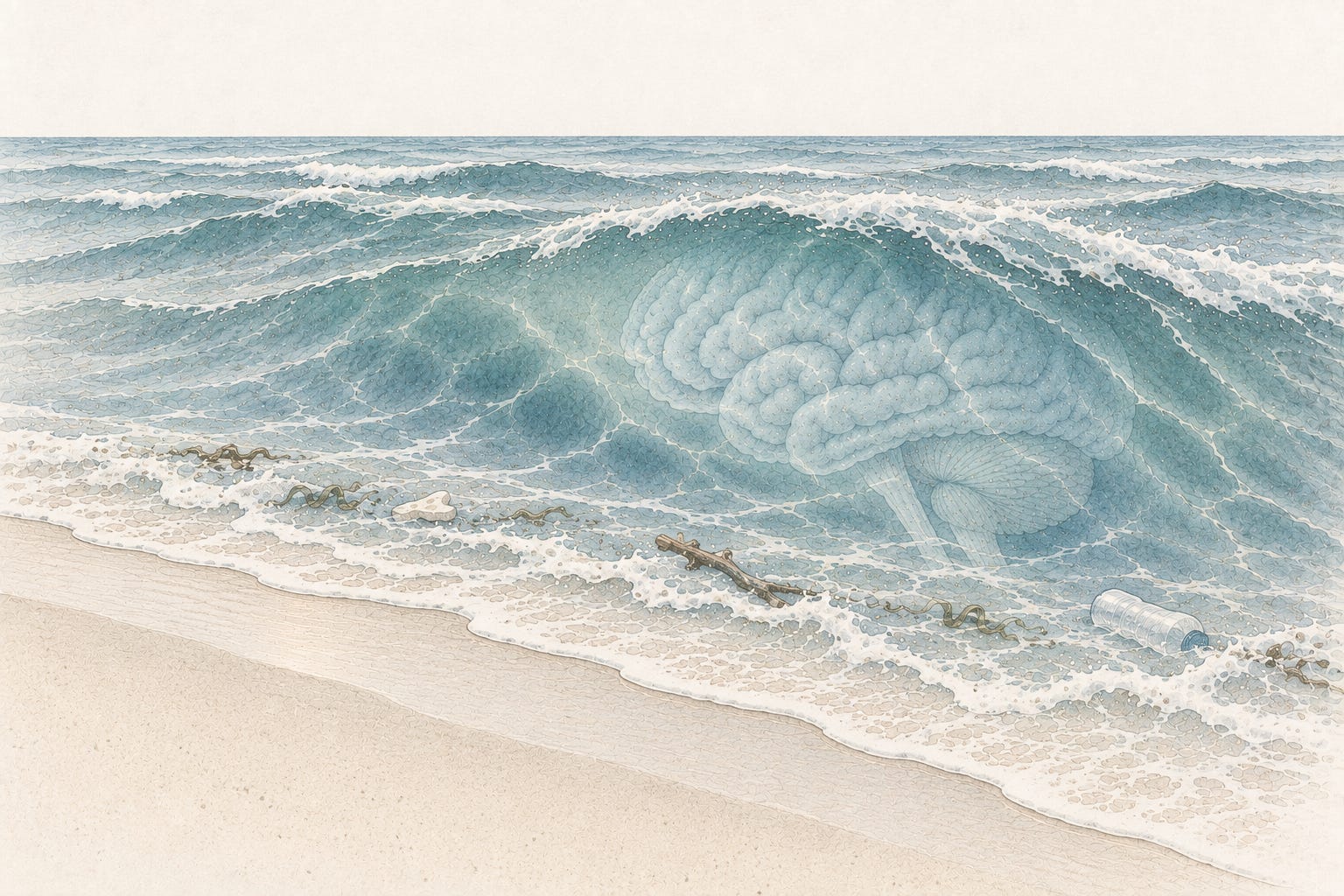

It’s such an intriguing picture to imagine. During non-REM sleep, rolling waves in our brain’s inland sea push debris toward the shore, where trains of biological trash collectors can move it to our body’s waste dump. If it turns out that this is how things work, it’s plausible that increasing these waves could help people whose sea no longer rolls. In fact, Levitt and Lewis recently cofounded Cerebloom Inc., a company hoping to develop an at-home device, such as a headband, that could boost CSF waves while we sleep.
However, here’s why this image is still fantasy. We know the brain has a waste-management system that involves CSF, but we don’t know exactly what these waves do. Levitt and Lewis only showed they could increase wave flow, not its impact. So it’s unclear how stronger waves affect the rest of the trash-processing chain.
Still, this research matters because it offers a possible non-invasive way to influence what happens in a sleeping brain. I look forward to more research on whether changing these waves affects brain function.

Start with the boring stuff. Some of the strongest brain health research points to the benefits of sleep, exercise, diet, hearing protection/correction, social engagement, and challenging your cognitive capabilities. New shiny widgets are exciting, and I’ll certainly be covering them. But before jumping on the newest gadget, make sure you’re optimizing your lifestyle for your brain’s health.
Get your sleep in order. Poor sleep is closely aligned with cognitive decline. It can be both associated with, or even be a symptom of, neurodegenerative disease.
Wait for more research. A headband designed to increase CSF wave flow is intriguing. However, wait for more research on whether the headband’s impact matters before deciding to buy.

Levitt J, Zeng X, Yang Z, Jacob LPL, Lewis LD. “Closed-loop auditory stimulation in phase with slow waves during sleep enhances cerebrospinal fluid flow in humans.” Science Translational Medicine. 2026;18:eaea5469. DOI: 10.1126/scitranslmed.aea5469.


I always write this section with the best of intentions, though my track record is abysmal. I’d love feedback on whether it’s important to preview what’s up next or keep it a surprise.