

Neuroscience researchers have long suspected that the brain’s energy production may play a role in a number of disorders. A small ketogenic diet study in schizophrenia and bipolar disorder became a lens to focus on a larger question: are we measuring the right kind of metabolic health? This Field Note explores why answering that question could change how we think about brain health.
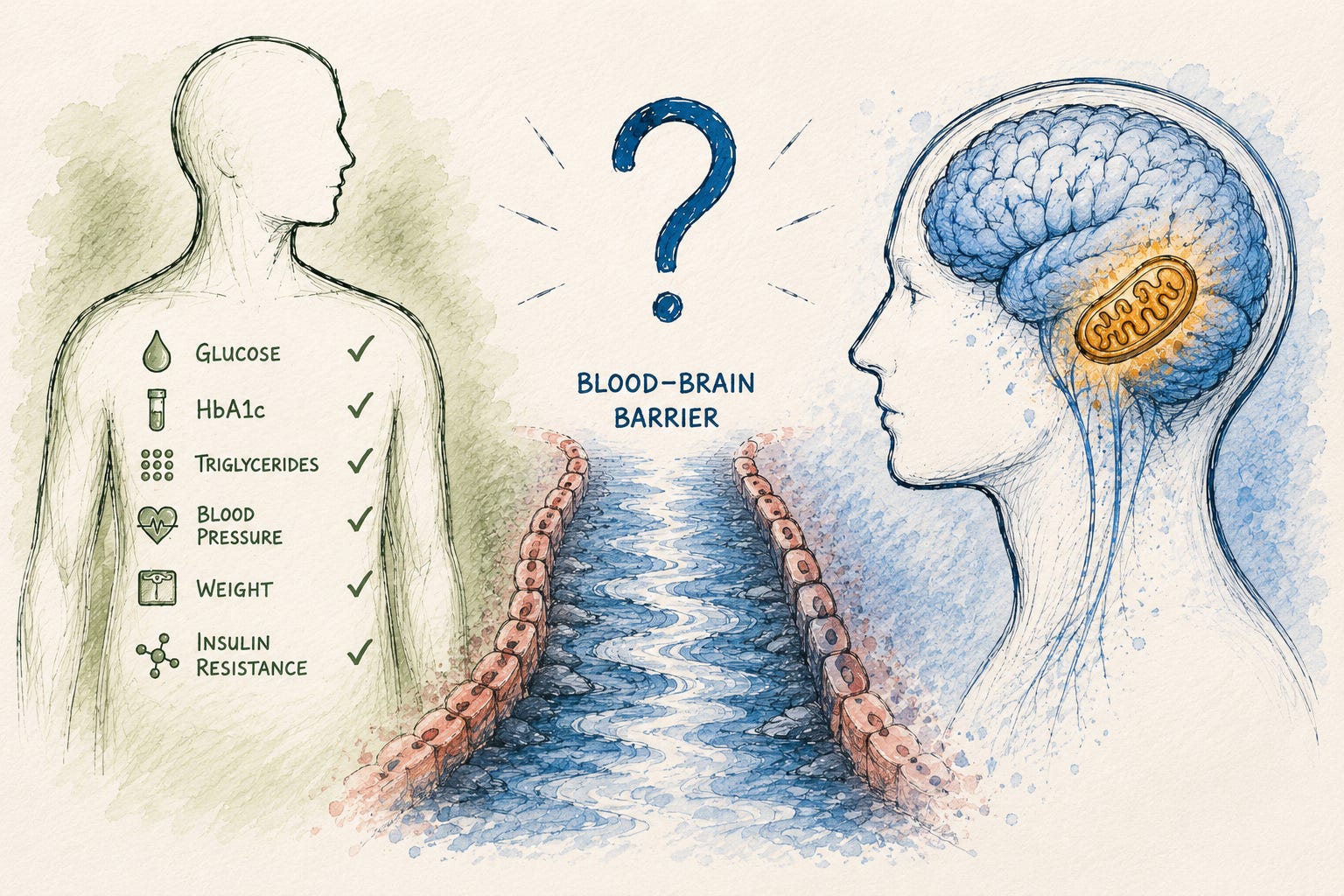

At the end of Field Note 3, I said I’d next move into FINGER and POINTER, two major studies on cognitive decline and Alzheimer’s disease. But as I dug into those studies, I realized we were missing a key part of the story: brain energy metabolism, one of the primary targets of these studies.
I first encountered brain metabolic health listening to Christopher Palmer, MD, on the Huberman Lab podcast. Palmer argues that metabolic dysfunction may underlie schizophrenia, bipolar disorder, and some depression — and, as I noted in Field Note 3, it may play a role in Alzheimer’s as well.
If that holds, a failure in brain energy metabolism could sit upstream of symptoms we currently treat one at a time.
This brings us to this Field Note, which focuses on brain cell metabolism. To illustrate the story, I’m using the ketogenic diet as a lens into a much bigger question: how does the brain produce energy, and how do we measure it?

One of the more intriguing paradoxes in brain health is that many medications used to treat severe mental illness improve symptoms while simultaneously worsening metabolic health. Weight gain, insulin resistance, and metabolic syndrome are common side effects of antipsychotics, antidepressants, and mood stabilizers.
The consequences are far from trivial. As Shebani Sethi, MD, and colleagues point out, metabolic syndrome is extremely common in people with severe mental illness, who die an estimated 10–25 years earlier than the general population, largely because of premature cardiovascular disease. Dr. Sethi is a leader in the field of metabolic psychiatry, having coined the term.
I’ll admit I read that the way most people would: metabolic health is metabolic health.
Against this reality, Sethi and her team ask a straightforward question: If we improve metabolic health in patients with schizophrenia and bipolar disorder, do psychiatric outcomes improve as well? I’ll admit I read that the way most people would: metabolic health is metabolic health. When you improve the bloodwork, you improve the metabolic health of the body and the brain. They chose the ketogenic diet to treat metabolic dysfunction.
My intro to ketogenic therapy was reading Georgia Ede, MD’s book Change Your Diet, Change Your Mind. Through her work, I also discovered Iain Campbell, PhD, whose personal experience with keto and bipolar disorder led him into metabolic psychiatry research. I’ll return to Dr. Campbell’s work in a future Field Note.
Ketogenic therapy is hardly new. It’s been used to treat drug-resistant epilepsy, particularly in children, since the 1920s. Testing it in psychiatry is a logical step because several anti-epileptic medications are common bipolar disorder treatments.

As with the patients we discussed in Field Note 2 (vagal nerve stimulation for treatment-resistant depression), participants in the Sethi study were severely ill. Thirty-eight percent had previously attempted suicide. Participants completed extensive psychiatric testing and metabolic assessments before beginning the ketogenic diet and returned for ten follow-up visits over four months.
The improvements, on the surface, appear striking.
29% met the criteria for metabolic syndrome at the beginning of the study. By the end, none did.
Clinical Global Impression severity scores improved by an average of 31%.
Roughly one-third of participants were in recovery at baseline. By the end of the study, approximately three-quarters met recovery criteria, and all adherent participants met the study’s recovery criteria.
Nearly 80% of symptomatic participants experienced clinically meaningful improvement.
For participants who adhered closely to the diet, estimated 10-year cardiovascular disease risk fell by about 11%: triglycerides decreased, HDL cholesterol increased, and blood pressure decreased. One exception was that LDL cholesterol went up 21% on average.
Viewed in isolation, these results make the ketogenic diet look remarkably effective. But do they tell the whole story?

Both psychiatric and metabolic benefits are real, and in a population with decades of illness behind them, patients suffering less is something to celebrate. But Sethi’s paper sent me in a different direction than I expected.
The metabolic and psychological improvements are encouraging, but there was no control arm, so we can’t say ketosis caused them. Weight loss alone might have. Very low-calorie diets and GLP-1 medications improve many of the same markers, and Sethi’s participants lost about 10% of their body weight. We also know from other studies that severely ill people improve simply by receiving close attention and fresh hope: reasons unrelated to the treatment itself.
At this point, I was ready to end the Field Note. Interesting pilot. Too many limitations. Wait for a bigger trial.
And yet, something was bugging me. What if the improvements, especially in mood, came from something ketosis does inside the brain that weight loss alone can’t explain? What if Sethi’s markers captured only part of the picture? What if something was happening in the brain that blood tests were never going to see?
What’s Going on Upstairs?
The markers Sethi’s team measured (insulin resistance, HbA1c, triglycerides, weight, waist circumference, and metabolic syndrome) tell us a great deal about the body’s metabolic state.
Think of it like checking the thermostat in your living room. If it reads 75°F, you have a pretty good idea the entire house is comfortable. But it doesn’t tell you whether the bedroom upstairs is the right temperature for sleeping. You don’t know until you go up.
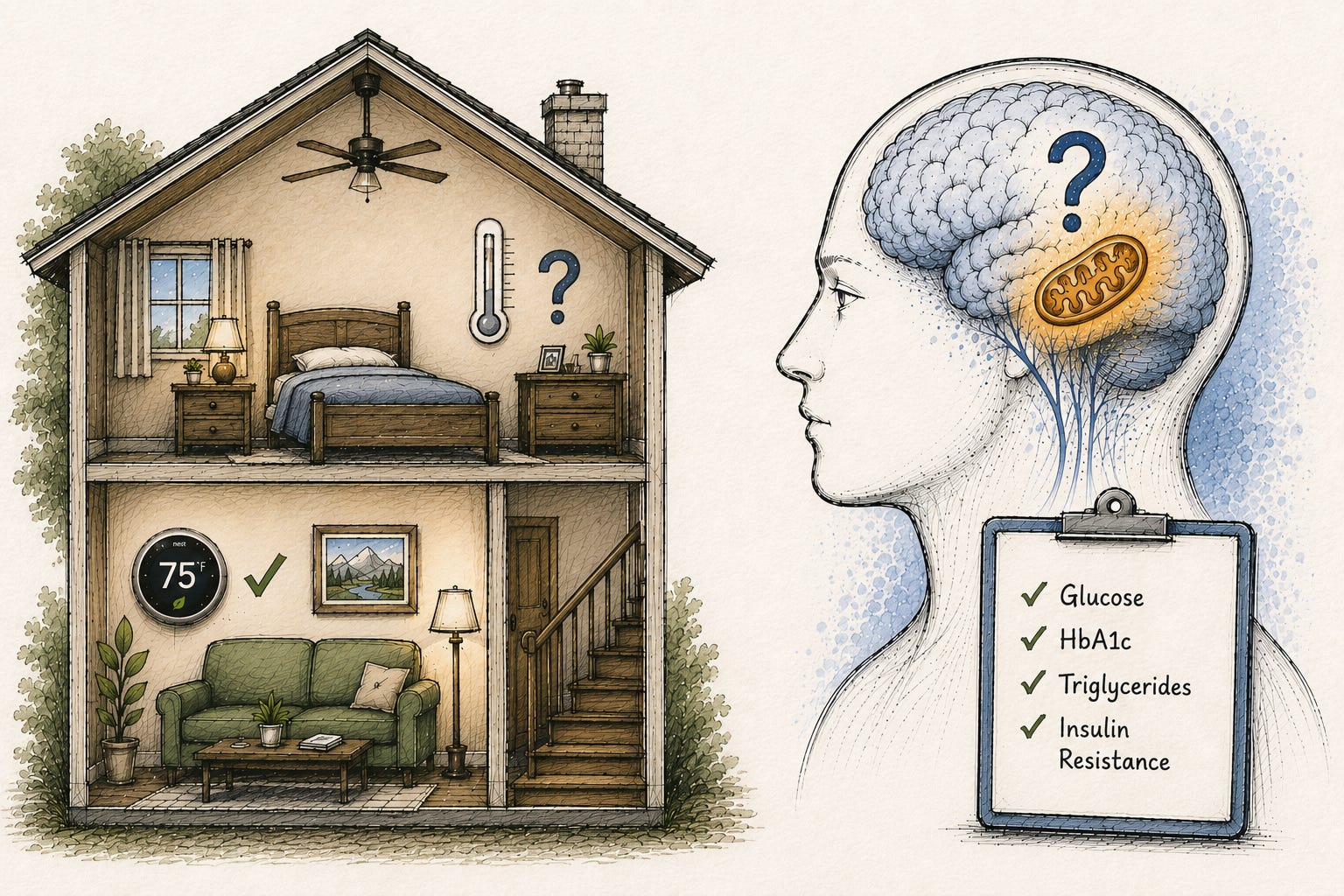
Blood tests are much the same. For all their detail, they can’t tell us whether neurons on the other side of the blood-brain barrier can still take up glucose and convert it into usable energy. Good metabolic health in the body doesn’t necessarily mean the brain is using energy normally.
It does something no weight-loss diet can: it gives neurons a second fuel, ketones, alongside glucose.
This may be the foundation of why neuroscientists are so interested in ketosis. We already know ketones readily reach the brain; ketogenic therapy has treated epilepsy for a century. And it does something no weight-loss diet can: it gives neurons a second fuel, ketones, alongside glucose.
Keto may be less a way to improve metabolic health than a way to ask a deeper question: how does the brain produce energy, and what role might that play in mental health? This may prove to be one of the more important questions in neuroscience.
These ideas are also central to some clinical practice. One of the best-known examples is Dale Bredesen, MD’s ReCODE (REversal of COgnitive DEcline) protocol, which includes nutritional ketosis as one element in a multidomain strategy.
I’ll devote a future Field Note to ReCODE because it raises a bigger question: Can a collection of biologically plausible interventions become more than the sum of its parts?

The Sethi study showed dramatic improvements in systemic metabolic health, but without a control group, we can’t determine how much of that benefit was attributable to ketosis versus weight loss. In other words, weight loss is a great step toward reversing metabolic dysfunction, and keto is one way to get there.
The psychological improvements are encouraging, but a larger controlled trial is needed to determine how much of the benefit was due to ketosis itself.
Ketosis has become scientifically interesting because it provides the brain with an alternative fuel.
If you try keto, watch your LDL: it rose 21% here. That’s a real cardiovascular flag to track with your doctor.

Scientific Paper
Sethi S, et al. Ketogenic Diet Intervention on Metabolic and Psychiatric Health in Bipolar and Schizophrenia: A Pilot Trial. Psychiatry Research. 2024;335:115866.
Books & Researchers
Podcast

If blood tests only provide a hint of what’s happening inside the brain, what opens that window? Next, we’ll explore cerebral glucose hypometabolism and how imaging of an aging brain reveals metabolic changes long before symptoms appear.
