

Losing one’s sense of smell may be one of the earliest signs of Alzheimer’s. We don’t know why. The usual suspects are often named: inflammation, amyloid plaques, and even the brain’s own sanitation crew going rogue. A recent mouse study provides surprising new insights: the damage isn’t inflammation, and the cleanup crew is doing its normal job. If the findings hold up in humans, it points toward the possibility of spotting Alzheimer’s much earlier than we can today.
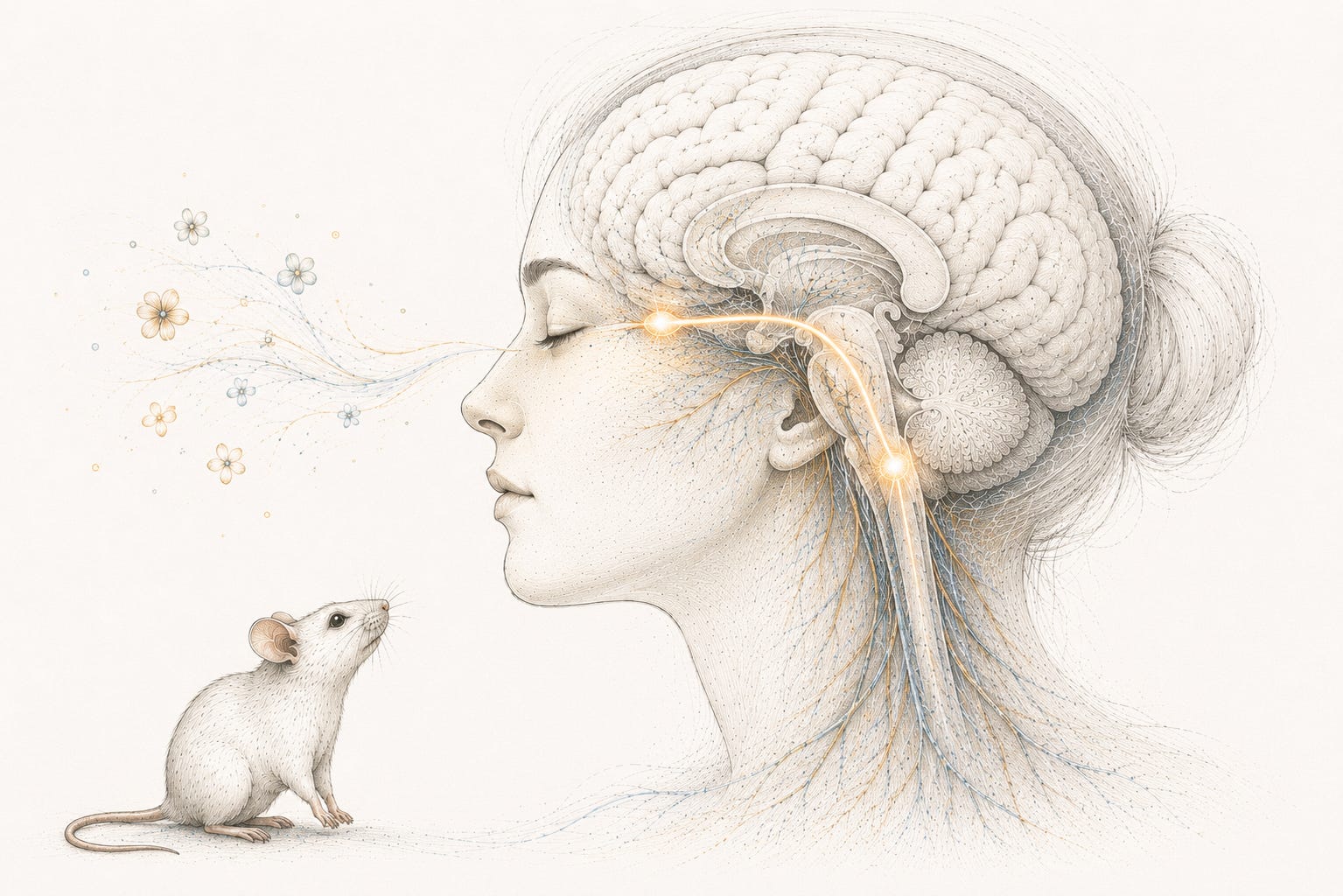

“Hyposmia might be the canary in the memory coal mine.”
I was surprised to learn that 85% of Alzheimer’s Disease cases involve a reduced sense of smell (hyposmia). Why does the sense of smell degrade? As you’ll read, hyposmia might be the canary in the memory coal mine. Notably, unlike in Field Notes 1 and 2, inflammation is not the lead actor here.

Meyer and colleagues set out to answer a simple question: What actually causes smell loss early in Alzheimer’s disease? The central player in this research is once again the locus coeruleus, previously discussed in Field Note 2. This small brainstem nucleus sends noradrenaline nerve fibers throughout the brain, including to the brain’s smell-processing center, the olfactory bulb.
They hope that understanding the mechanisms linking the locus coeruleus to the loss of the sense of smell can lead to earlier detection of Alzheimer’s and potential treatment. Of course, this is a mouse study, and as I wrote previously, Mickey ain’t me. We’ll get back to this later.

“The microglia are not inflamed; they are just doing their job.”
For the research, the team used mice predisposed to Alzheimer’s (at least as far as mice Alzheimer’s goes). These mice express three mutations that promote the accumulation of amyloid beta. While no mouse fully reproduces human Alzheimer’s disease, this model captures several features researchers believe are important in the earliest stages of the disease.
In case you’re wondering, how do you ask Mickey to “smell” something? They did two things. First, they timed the mice to find buried food. Second, they ran experiments to measure the function of the locus coeruleus and the olfactory bulb while exposing mice to various scents (e.g., vanilla, lemon, banana).
Their primary discovery is that mouse hyposmia results from the loss of locus coeruleus connections to the olfactory bulb, occurring well before detectable amyloid plaques appear: neurons survive, but their axons degenerate. I assumed inflammation would be a factor. Instead, it turns out it’s the brain’s trash collectors, the microglia, doing their day jobs.

But why? And why is it first happening in the olfactory bulb, even though the locus coeruleus connects to multiple brain regions, including the hippocampus?
The researchers think that the brain’s smell-processing center may be more vulnerable to this cleanup process than other regions. One possible reason is that it is one of the few regions that undergoes ongoing neurogenesis and remodeling.
Here’s the entire story in four simple steps:
A normally functioning locus coeruleus neuron provides a regular pulse to the olfactory bulb, helping to modulate its function. Think of it like a volume knob on a radio. In Alzheimer’s mice, these neurons act abnormally.
Meyer postulates that the dysfunctional axon exposes an “Eat Me” signal. I think of it like a giant Post-it note that catches the attention of nearby microglia. This signal is phosphatidylserine on the axon surface.
The microglia detect the signal and destroy the axon. In other words, the microglia are not inflamed; they are just doing their job.
The connection is lost. The smell signal weakens. The mouse takes longer to find buried food.
To validate their findings, the researchers used additional techniques. For example, they used specially bred mice whose microglia can’t destroy the axon, even when the “eat-me” flag is up. These mice kept their sense of smell intact into “old age.”
If these findings translate to humans, the earliest signs of Alzheimer’s may be the loss of these connections to the brain’s smell-processing center. If so, it could give researchers a new window into the earliest stages of the disease. Whether that leads to earlier diagnosis or treatment is unknown, but it offers another clue about where to look. After all, hyposmia may occur long before cognitive decline.

Though Meyer presents an elegant study of mouse Alzheimer’s-like brain dysfunction associated with olfactory loss, it is just a mouse study. Even so, it provides another clue for researchers investigating the role of the locus coeruleus in Alzheimer’s and other conditions, including Parkinson’s disease, and Lewy body dementia.
In terms of inflammation, I’ve listened to a few recent lectures by well-known experts in this space discussing “good” and “inflamed” microglia, a bit of a Jekyll and Hyde view of the brain’s janitors. Meyer’s research suggests that this early mechanism may not fit neatly into the good-versus-bad microglia framework at all.

Last week, a good friend said, “I find your blog very interesting, but I’m not sure what to do with it. There’s nothing actionable.” I get it, and I realized that I’m missing an opportunity to be helpful. So, starting today, I’m adding this “Key Takeaways” section. Rather than a list of things to do – or not do – it’s a way to put the research in context. Sometimes it will be actionable, but many times, as in this field note, it will hopefully just be reassuring.
Here are my three takeaways from this research:
Next time your smeller is out of whack, don’t panic. There are many reasons (e.g., COVID, sinus infection, allergies) that can reduce your sense of smell. The odds are in your favor. Millions of people experience olfactory deficits; this is rarely due to neurological problems. However, if it persists, you should seek medical advice.
One unreplicated mouse study cannot tell us what happens in humans. It does, however, provide another clue for further research.
This study adds to growing evidence that brain dysfunction may begin long before any cognitive deficit. The main takeaway is that loss of smell may be an early clue. This finding gives me some hope that researchers are looking more upstream than ever before.

Meyer, C., Niedermeier, T., Feyen, P.L.C., et al. “Early Locus Coeruleus noradrenergic axon loss drives olfactory dysfunction in Alzheimer’s disease.” Nature Communications 16, 7338 (2025). https://doi.org/10.1038/s41467-025-62500-8

As I look out onto the Field Notes horizon, I’d like to understand better why the locus coeruleus is such a central figure in brain dysfunction and explore the upstream processes (e.g., mitochondrial dysfunction) that may be at play. If Meyer’s research ultimately applies to humans with underlying biological changes beginning long before cognitive decline, is there anything we can do about it?
I’m hopeful that the answer is “yes.” My next Field Notes will explore two major human research studies, FINGER and POINTER, to see if they offer any new clues about preserving brain health before symptoms appear.

If you’re not a subscriber, please subscribe to get full access to the newsletter and publication archives.
Canada has a higher rate of Alzheimers than the US, and Mexico has a much lower rate of Alheimers. This seems to be a disease of industrialism (Japan has the highest rate; China has a slightly lower rate than the US, despite having an older population).
The nun study may provide an explanation. It showed that an essay written in young adulthood predicted who would suffer from dementia in old age. People who wrote 'idea rich' essays had resilience against dementia in later life. How does this relate to industrialism? Industrialism deskills living. You don't need to be 'idea rich' to get by in an industrial society. You don't need to call upon community resources, and you don't need to keep solving the problems of daily living.
Marcel Proust connected memory to smell in his novel In Search of Lost Time. More recently cognitive psychologists have determined that our brains generate our perceptions by fusing the data that comes in via nerves, etc. So an odor is an artifact of our brains, one created in real time. Memory is also modifiable (which is why we can learn from experience). So it is not surprising that brain destruction affects these particular subsystems.